weather

Watching the storm roll in

Check out this nice piece of time-lapse video of clouds and rain rolling over Kowloon, initially East to West (across the camera line of sight), but sometimes and later southward into the camera. Kudos to Christopher DeWolf.

http://www.urbanphoto.net/blog/2010/07/06/watching-the-storm-roll-in/

Average number of typhoons forecast for 2010

After seeing news re unusually active Atlantic hurricane season being forecast, just checked about forecast for Wast Pacific tropical storms n typhoons, from Hong Kong's City University:

Quote:
For the number of tropical storms and typhoons, most of the predictors consistently forecast a below-normal activity (ranging from 24 to 26) and therefore a below-normal TC activity (24 tropical storms and typhoons) is expected for this category
...

Severe Tropical Storm Fengshen heads towards Hong Kong

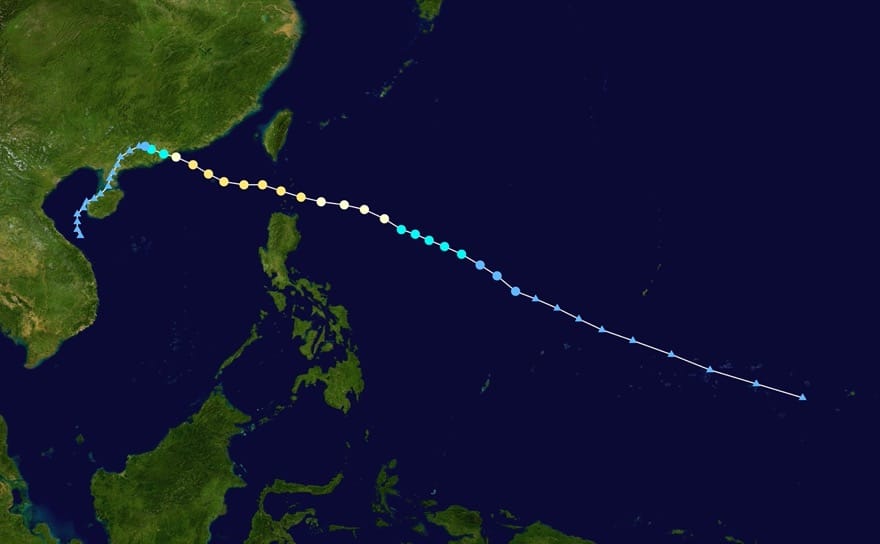
Severe Tropical Storm Fengshen - which had hit Philippines as a typhoon, killing several hundred people (mainly in ferry that sank) - was forecast to head towards Taiwan. But now, looks to be coming roughly straight for Hong Kong. HK Observatory has issued Number Three signal.

Pabuk

Severe Tropical Storm Pabuk looked set to have passed Hong Kong, barely causing an impact other than a pulse of thunderstorms, some rain. Headed towards Hainan, and forecast to dwindle to nothingness. But, it stopped, strengthened again, and turned around - and headed straight for Hong Kong as a tropical storm, hitting on 10 August; seems the rather hazy centre hit Lantau, before it moved off towards west, and weakened..
Led to hoisting of Number 1 and then, a couple of hours or so later, the Number 8: latter causing massive confusion, as people scurried home from work.

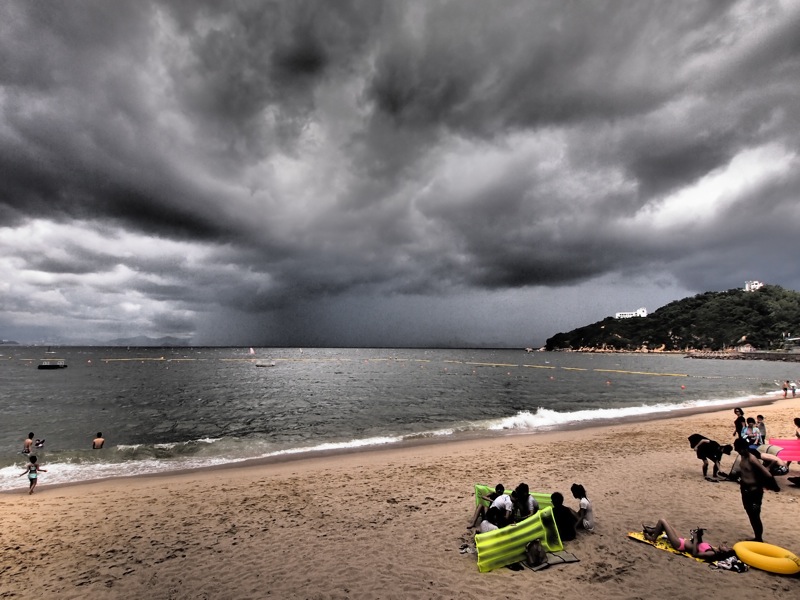
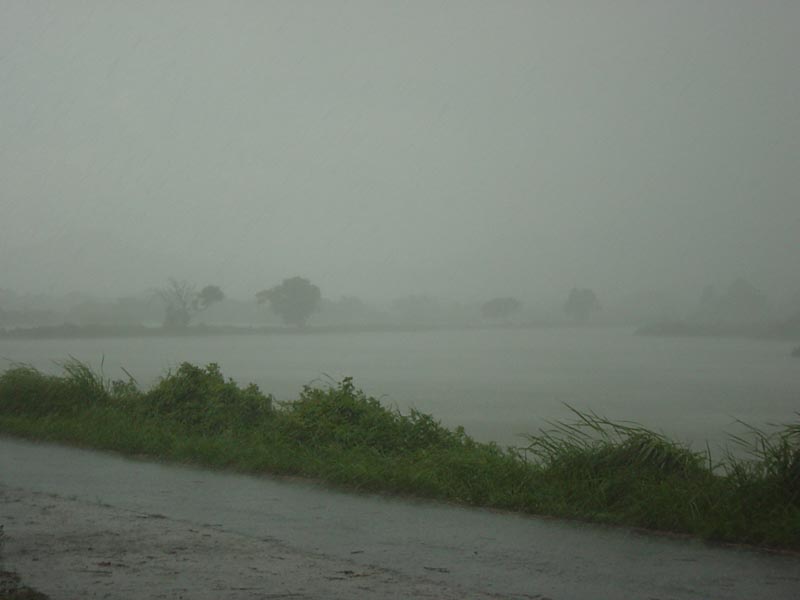
Here are views from Cheung Chau, as Pabuk approached (again!), and as it came close, with intense rainband.


This windspeed chart from Cheung Chau weather station shows the wind peaked roughly as I took the above photo, at around 100km/hr (10-minute average): storm force, tho soon down to gale force.


I had to take a ferry. As I neared the pier, passed bicycles blown over by powerful wind, and this broken tree branch.

The ferry took 15-20 minutes just to leave the pier! - blown against it by the wind!
Even in the typhoon shelter, the gale to storm force wind was blasting small waves w white water. Here, took shot in pelting rain.
{mov}pabuk-ferryrideweb{/mov}
There were big waves - some 3-4 metres? - soon after the ferry left the typhoon shelter. The ferry took an unusual course, to avoid as much as possible the roughest seas towards Hong Kong - north past Hei Ling Chau, to pass near Peng Chau. Even so, once we were beyond the lee of Hei Ling Chau, the ferry rolled in big seas; a few times, rolled pretty far then hit by waves that sent spray to windows of middle deck (where I was).
I shot these clips, inc as arrived in Victoria Harbour.

Calmer in the harbour, tho some dark clouds moved over.

I arrived in Central to find large crowd of people, waiting to catch ferry to Cheung Chau. (and go home - not for holiday!) The Number 8 was imminent, or up already.
{mov}pabuk-ferryrush{/mov}
Took quite some time for ferries to arrive. When a small - two deck - ferry berthed, there was degree of chaos as people rushed along exit way, dashed onto ferry without paying, w much shouting. But then, gate closed behind them, and things quiet again: the ferry left, and I figured I was glad not to be on it, as surely would bounce even more than three-deckers (as I'd come in on).

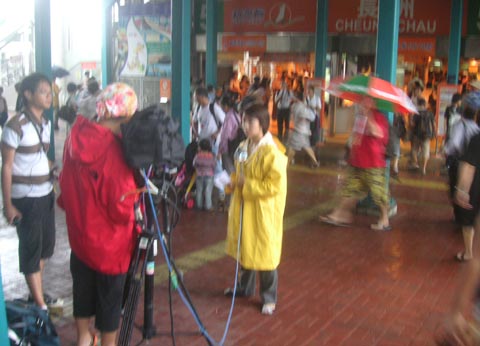
There were tv news crews around, reporting on people waiting for ferries. (Maybe, too, on the storm - but in Central it was pretty quiet; hard to guess how rough the seas were towards Cheung Chau, and how strong the wind had been there.)


Later, I came back to the ferry pier - sure the Number 8 must go down soon, and wanting to take ferry home (as little to do in town after collecting my family; we'd had coffee, eaten, been to supermarket, waleked by closed shops, checked HMV, and now just waiting, waiting and waiting at the pier). Boring, tho the harbour looked attractive w reflections on water free of boats: rather frustrating to be waiting like this when the harbour was calm as a mill pond!

THe piers were near deserted; a few others waiting for ferries and - as here - still a few news crews hanging on.

At last came annuncement that Number 8 replaced by Number 3; ferries didn't start at once; Lamma ferry off before Cheung Chau one even appeared), but we could eventually head home - phew!

HK Number 8 Signal

Hong Kong's Number 8 tropical cyclone warning can be controversial; the signal means that gale force winds are expected or blowing in Victoria Harbour. Especially as this may mean hurricane force winds may soon follow - as the eye of a typhoon approaches - this signal can prompt a virtual shutdown of Hong Kong.

But, hurricane force winds rarely follow; and there have been occasions when the Number 8 has been issued, then little happened bar strong winds and rain - and business folk have complained about the city shutdown causing economic losses they believe are unnecessary.

Hearing a discussion about Hong Kong's tropical cyclone warning signals on RTHK Radio 3 recently, I emailed to suggest that there might be two signals when gales are due: a Number 8 if stronger winds don't seem imminent, and another signal if there appears to be a chance that the winds will reach and then surpass gale force. Dr Wong of the Hong Kong Observatory, who was on air at the time, thanked me for my suggestion but said we already have the second signal - the Number 9. But, the Number 9 is issued only when gales are blowing and increasing, not before gales have started; I emailed the Observatory to say so, and this led to the following correspondence.

Hong Kong Typhoons

Typhoons have long impacted Hong Kong - even the word "typhoon" is said to be derived from the Cantonese "tai fung" - big (or great) wind. Just months after British sovereignty over Hong Kong Island was first declared in 1841, "a violent typhoon flattened all the insubstantial housing and damaged shipping." (Endacott, A History of Hong Kong.) (For a little info on how typhoons form, and Hong Kong's typhoon signals, see my article Hong Kong tropical cyclones.)

Hong Kong tropical cyclones

Hong Kong lies in the tropical belt that's impacted by low pressure systems that can intensify into the world's most powerful storms: known as hurricanes in North America, cyclones in Australia and the Indian Ocean, and typhoons in the western Pacific. Happily, typhoons are scarce near Hong Kong, and rarely score direct hits (13 from 1946 to now) - but can be spectacular and deadly when they do impact the territory.

As they need warm sea water to spawn and grow, tropical storms are rare in winter, mainly occurring from around May to October - with Hong Kong mostly affected from mid-August to early October.

Hong Kong weather and hiking

Hong Kong's climate is sub-tropical, with a hot, steamy summer eventually yielding to a drier, warm to hot autumn, then sometimes cool winter, and the swiftly warming, sometimes rainy spring. There are two major monsoons, with fairly consistent winds: the southwest monsoon of summer, which can bring great deluges, and the northeast monsoon of winter, which can be surprisingly chill. And, especially in late summer, Hong Kong is sometimes impacted by tropical storms, which when most intense are among the world's most powerful weather phenomena: typhoons.

Though the summer temperatures may not seem extremely high - the record for Hong Kong is 36.1C, and more typical daytime highs are around 31-34C - it feels considerably hotter because the humidity is high, often 80 percent or more. (A table on this Heat index and wind chill index page indicates that with a temperature of 33C and 80 percent humidity, it feels like 47.3C; it's effectively so much hotter because sweat barely evaporates, so you hardly cool down.)

And, in many places, it actually is hotter - the temperature records at the Hong Kong Observatory in Tsim Sha Tsui are often one to two degrees lower than those recorded at other weather stations (in winter, these stations may record lower temperatures than the observatory).

Even at night, the temperature doesn't drop much below 30C, so hiking at dawn and dusk isn't real comfortable either. Perhaps surprisingly, Hong Kong in summer can be a darm sight more uncomfortable than even some places nearer the Equator - in large part I think because of the sustained high humidity.

This heat means that summer isn't a time for long hikes; indeed, even short hikes can seem relatively hard going on the hotter days. And if you aim to be active outdoors, take care! Occasionally, hikers have died of heatstroke; others have suffered dehydration.

Syndicate content