Hong Kong news

Hong Kong Earth Champions Community Day

Earth Champions are people who have been nominated by their local community for making a positive difference to their environment.

Sparrows the scapegoats for H5N1 in chicken farm

Ah, isn't ignorance bliss, especially when you're an "expert".

Today's South China Morning Post has a report including:

Quote:
Experts who visited the Yuen Long chicken farm at the centre of the latest bird flu outbreak found important evidence flying around - sparrows.
The experts believe that chickens and sparrows, which can carry the H5 virus, living together signalled a serious failure in the farm's bio-security measures and may have caused the bird flu outbreak last month.

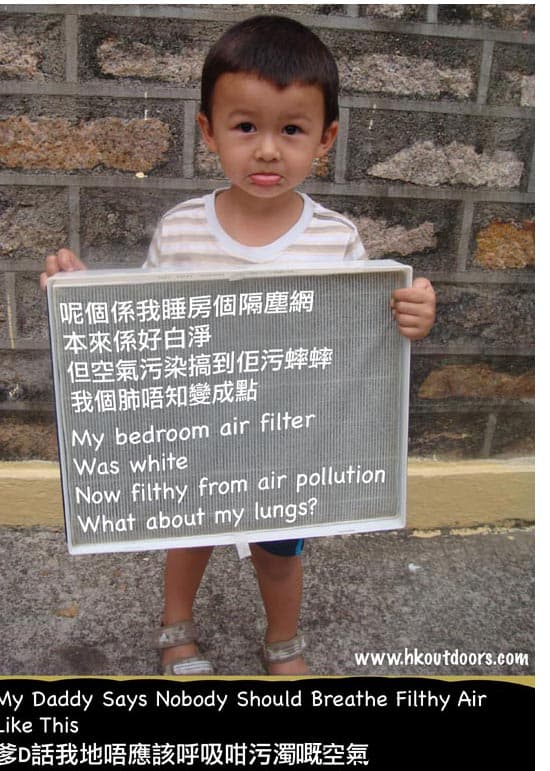
Hong Kong's Dangerous Air

The Hong Kong Government seems to be downplaying or misinformed about the health impacts of our air pollution, Chief Executive Donald Tsang has even said: “It is a question of visibility.”

Hillfires

Hong Kong’s Easter/Ching Ming holiday, at the beginning of April [1999], coincided with a spell of fine, clear weather: conditions that should have been ideal for hiking. But a ridge walk in the northeast of the SAR was spoiled by the sight of smoke rising billowing from a fire raging below the ridge, as well as plumes of smoke and snaking orange lines as more fires burned on other, more distant hills. Elsewhere, too, there were abundant reports of fire on this and the previous day, the Ching Ming Festival proper—when 224 hillfires were recorded throughout Hong Kong.
    Every year, Hong Kong’s hillsides are afflicted by fires like these. Overwhelmingly, they rage during the late autumn and winter, when long dry spells can make grass and ferns tinder dry. The Fire Services Department logged 2668 vegetation fires last year, a total almost matched during the exceptionally dry, first four months of this year, which saw 2387. There are a variety of causes, including day-trippers dropping cigarettes or being careless with barbecues. But a disproportionate number result from people observing traditional grave sweeping ceremonies, at Ching Ming in spring and (more usually) Chung Yeung in autumn—roughly a tenth of the hillfires last year and so far this year happened on these days.
    Dr Cheng Luk-ki, campaign coordinator of Friends of the Earth, says some of the fires started during grave sweeping ceremonies arise from thoughlessness, as people burn joss sticks and paper money without regard to embers blowing into the undergrowth, and toss firecrackers around (to scare off demons). “But some people also like to clean up the area around the grave, or make sure it’s easy to reach, by lighting fires,” he says.

HKZM bridge pollution

Here's a letter (by me) to the editor of the South China Morning Post; published on 8 December 2005.

I was interested to see that the map of air quality in the Pearl River Delta on 30 November (SCMP, 1 Dec) showed a zone of relatively clean air over Zhuhai and Macau. This presumably results from Zhuhai and Macau having little industry.

As and when the Hong Kong-Zhuhai-Macau Bridge is built, this situation could change dramatically. The bridge is largely aimed at spurring development in Zhuhai - perhaps so it can mirror places along the east shore of the Pearl River Delta. With increased development will come increased air pollution, impacting not only Zhuhai and Macau but also adding to air pollution in Hong Kong.

Given that air pollution in the Pearl River Delta Region is already severe - as I write this, the sky is clear yet the air is grey with smog - perhaps bridge proponents could explain just why Hong Kong should contribute to the project, and so help push our air pollution from very bad to even worse.

Rockit 2005

Hong Kong's Rockit Music Festival just on in Victoria Park, Causeway Bay. Though only a couple of international bands this year (one a rapper with band - Princess Superstar; the other UK rock group Feeder), still a fun weekend - tho dunno if the bureaucrats-that-be may be persuaded that's a good thing, and this can be an asset to HK, deserving some support.

Here are some photos, also some guff re the event. 


No Flu at Mai Po

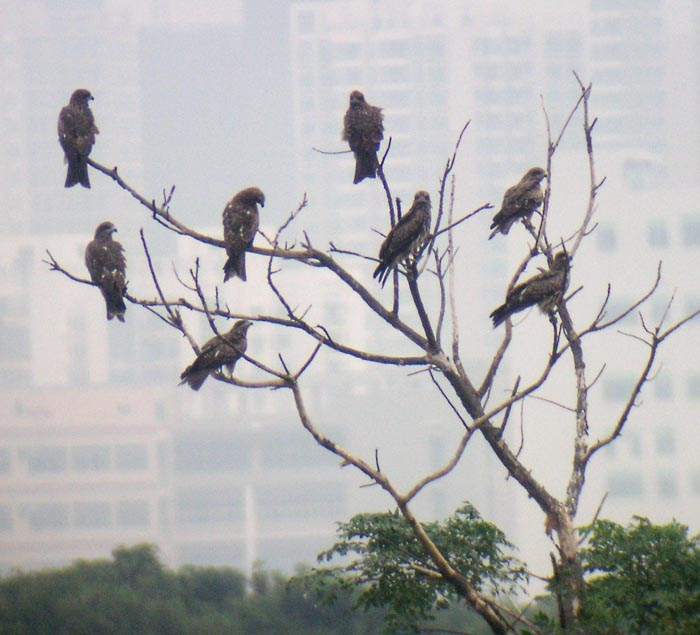
Went birdwatching at Mai Po Marshes Nature Reserve, in northwest Hong Kong, today. Whilst there, I grabbed some photos using digital camera thro telescope - including this one.

Now, what do you reckon the Black Kites are doing in this tree?

a) Waiting to feast on the bodies of H5N1 bird flu victims.

b) Feeling very ill, and ready to fall on their backs, legs waving in the air, as they succumb to the great pandemic of 2005: ie Bird Flu Panic.

c) Trying to sit as high as they can, so they don't get caught up in the hysteria.

d) Just resting, on a tranquil Tuesday afternoon.

The answer - plus more photos and some guff about today - below.

Donald Tsang development

Here's a letter I sent the South China Morning Post, during the (ahem) election for Chief Executive.

Dear Sir:

It was good to hear that Donald Tsang plans to nurture an environment essential for our future sustainable growth and development. But I wonder if the envisaged sustainable growth and development is the kind that will safeguard our natural environment for future generations; or does it mean continual concreting, and never-ending projects and profits for developers?

Perhaps answers will be revealed through the Hong Kong-Macau-Zhuhai bridge project. This is within the Concept Plan for Lantau, which espouses "sustainable development". Yet, especially once it was decided to make the bridge road only, it instantly became an unsustainable project.

HK Deep Bay threats

Last decade, the future looked bright for the Deep Bay wetland, in northwest Hong Kong.

The British and Chinese governments agreed to list it under the Ramsar Convention on Wetlands of International Importance – showing they recognised it should be protected by “wise use”.

A slew of globally rare birds occurred each year, and numbers of waterbirds increased to a peak of around 70,000 in winter 1995/1996; great flocks of gulls, ducks and shorebirds treated visitors to what one birdwatcher called, “One of the greatest bird spectacles in Asia.” The Hong Kong Government helped expand the land managed by the World Wide Fund for Nature in the bay’s key reserve, Mai Po Marshes.

But now, many local conservationists are afraid Deep Bay – which is really a shallow estuary – is in steep, perhaps terminal decline.

Sham Chung qns for SHK

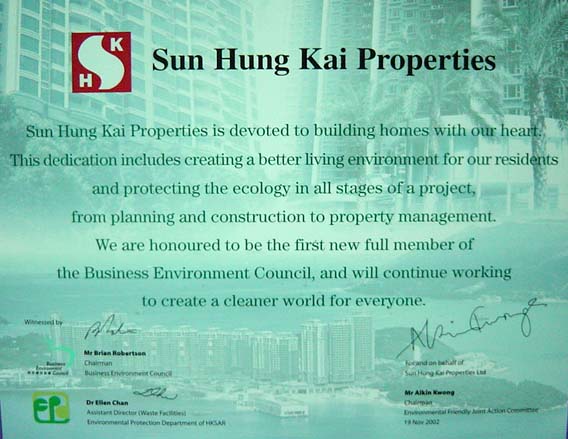
Several months ago, I heard that - through the Business Environment Council, which SHK Properties is a member of - Sun Hung Kai might be interested in answering some questions on their activities at Sham Chung. I wrote some questions, but so far have heard nothing.

So, if anyone from Sun Hung Kai pops by this site, perhaps they can contribute some answers.

Questions re Sham Chung, for Sun Hung Kai

So far, Sun Hung Kai seems to have a really poor record of activities at Sham Chung.
Notably, the old paddyfields area that was rated Hong Kong’s fifth best freshwater marsh has been trashed. At the time, this was the world’s top known site for the black paradise fish, but we now know this fish is actually the Hong Kong paradise fish, known only from Hong Kong.
- Are there any regrets within Sun Hung Kai regarding such environmental damage, or is it just part of business: you’re showing environmental concern by joining BEC, but when it comes to Sham Chung, do you care only about the bottom line? {Sun Hung Kai Properties' enviromnental commitment seems even more questinable now you're involved in plan to pull down brand new aparement buildings in Hung Hom.]

It also seems there has been work at Sham Chung that was supposedly by villagers or other organisations, but to some observers it appears this was a smokescreen, with work aimed at helping you build a golf course, or resort. [[Examples are the organic farm for disadvantaged children – just a façade? – and some field clearances by villagers.]]
Maybe, too, there was – and still is? – a belief that if the former ecological value of the old paddyfields is destroyed, and this area remains poor for wildlife, it will in future be far easier to obtain the go ahead for development. Even grass cutting is perhaps to minimise value to wildlife, to stop protected wildlife becoming established on cleared land.
- Any thoughts on these points?

What of your previous and current plans for the site? There have been reports regarding a golf course – golf course holes were built, but not used. Also a resort. Anything else?
It rather seems these plans were made by people who had little knowledge of or liking for Sham Chung: is that true? [I’ve seen a sketch showing a lot of resort bungalows built along a winding track/road; looked like it had been just drawn on a map by someone who had never been to Sham Chung.]

So now, the situation at Sham Chung is a mess; Hong Kong’s fifth best freshwater wetland is gone, green groups are unhappy, villagers are unhappy (perhaps both those who support and oppose developments like a golf course), Sun Hung Kai is surely unhappy. [Maybe not so much now the government has come up with a conservation policy including this site, allowing some development on ecologically poor areas - tho really, that shouldn't include areas that have been recently screwed, should it?]

Are you interested in looking at options that might make for a com-promise, might even make Sham Chung a good or great example for eco-tourism/sustainable tourism in Hong Kong? [Assuming such op-tions haven’t been looked at in detail; does not seem so.]
Might not be as profitable as a golf course or unimaginative resort; but just might make money – eco-tourism is big business worldwide, but is so far its potential has been barely tapped in Hong Kong.

There must be many possibilities to consider (again, assuming not all already looked at in detail); including:
 Renovate existing houses, so they still look great outside – they seem in harmony with the landscape – while inside might be good overnight accommodation for people working in the city, and some overseas tourists, as well as restaurants (with Hong Kong’s premier al fresco dining?), perhaps living folk museum, centre with information on wildlife;
 Museum aspect could also include some of the old fields – maybe with rice grown again, buffalo used to till soil [I’ve been to a Folk Village {Museum} in South Korea that was very popular: http://www.lifeinkorea.com/Travel2/kyonggi/219 If South Korea can have folk villages, surely possible in HK too]
 Nature trail, including the old woods;
 Cycling track, linking to other parts of Sai Kung Peninsula;
 Recreated freshwater wetland, improving on the paddyfields, and of course with the Hong Kong paradise fish;
 Maybe viewing facilities for nesting White-bellied Sea-Eagles (if they nest again);
 Kite flying, as former residents say they are planning.

Might be busy during daytimes on weekends and public holidays, but quiet otherwise, including in evenings;
Potential, then, for a relaxing resort (in one of the hamlets?) for businessmen – paying “good” money. We know someone [Andrew Jones] who could perhaps advise on this; he has helped establish award winning, low density resorts;
There’s perhaps also potential for targeting companies, by offering team building and related courses.

Unlike many of wilder parts of Hong Kong, Sham Chung is easily accessed – might be even easier if, as possible, the Science Park has quay for boats that can serve Sham Chung and other places in Tolo Harbour. So, might be possible to bring in money – whilst protecting the environment and wildlife, making a balanced development.

If you wish to explore such options, several people would likely be willing to help. What do you think?
{mos_sb_discuss:12}

Syndicate content