Also perhaps of interest: From France, signs of recoveries in insect and bird populations after some reduction in pesticide use [neonicotinoid ban, in this case] Full recovery could take years.
Dengue Suppression by Male Wolbachia-Infected Mosquitoes
Another day, another email to FEHD from me; re another form of mosquito-borne disease control that should have minimal adverse impacts:
A friend on exTwitter has just posted a link to a new paper on a study on the efficacy of Dengue Suppression by Male Wolbachia-Infected Mosquitoes in Singapore.
You will know of but failed to mention this technique; instead continuing to favour the sledgehammer/ blunderbuss-shotgun approach of pesticides – which is proven despite the known adverse impacts on other wildlife and even people.
//Insecticides, which are relatively expensive and can linger in the environment, killing other beneficial insects and damaging human health, can be used less frequently//
Well, I know of the term “smart city” for Hong Kong; yet also of there being a tendency to find reasons not to use new technologies etc.But, perhaps this control method is well worth trying; Hong Kong could become a hub for more advanced mosquito control in the Greater Bay Area/s China ??
FEHD emails recognising importance of balancing effective mosquito control with the preservation of biodiversity
From FEHD:
Thank you for your email dated 7, 8 and 12 February 2026 concerning mosquito control in Hong Kong.
This department understands your concerns about the application of pesticides and the potential overuse of chemicals, which may adversely affect both local wildlife and human health. We recognize the importance of balancing effective mosquito control with the preservation of biodiversity.
This department has consistently implemented comprehensive and targeted mosquito control measures. Our pest control approach follows the recommendations and technical guidelines of the World Health Organization (WHO), adopting the principle of Integrated Pest Management (IPM) in our mosquito control strategies, with emphasis given to source reduction and environmental control targeting at the immature stages of mosquitoes which must develop in water. ULV fogging is necessary when handling mosquito-borne diseases with an aim to suppress density of adult mosquito vectors swiftly.Insecticides used in ULV fogging, following recommendations of the WHO, only have brief knockdown effect.The active ingredients break down in hours when come into contact with air under sunlight. Adverse effect to non-target animals / wildlife should be minimal.
This department has been actively exploring and adopting more eco-friendly methods.This includes the introduction of innovative technologies such as the new type of mosquito trapping device (“MTD”), which is specifically designed to attract gravid mosquitoes to lay eggs. The device contains an insect growth regulator (IGR) and a fungus as active ingredients which target at the larval and adult stages of mosquito respectively. The principle of this trap is to attract female mosquitoes to lay eggs inside the trap where they come into contact with IGR and the fungus. The female mosquitoes then carry the IGR to other breeding places, preventing the larvae in those breeding places from developing into adult mosquitoes.The female mosquitoes themselves will also die within a few days due to infection of fungus.This department has deployed these MTDs in suitable places across the territory and has recommended that other government departments consider using this device appropriately within their managed areas as an auxiliary tool for mosquito control.
Additionally, we are currently exploring the use of Wolbachia-infected male mosquitoes as a biological control method against Aedes albopictus.The department is considering conducting laboratory and field trials to assess its applicability / efficacy in local environment.This approach aims to suppress mosquito populations while minimising harm to non-target species and ecosystems.
To ensure the pest control services provided by the contractors are up to standard and follow strictly to the contract requirements, this department has taken measures to strengthen monitoring of services provided by the contractors to ensure their mosquito control work is properly discharged, including safety and proper use of pesticides. We are committed to enhancing staff training and monitoring. This includes oversight to reduce environmental impact and protect biodiversity. This department has been and will continue to minimise the environmental impacts that might arise from the course of the mosquito control work without jeopardizing survival of non-target animals.
We value your input and are dedicated to improving our practices to achieve a balanced approach to mosquito control. We believe that through the integration of advanced technologies, community engagement, and continuous staff training, we can better protect public health while preserving our natural ecosystems.
Yet to me it seems FEHD doesn’t care about biodiversity
My response:
Thanks for the reply of 16 March.I’m cc’ing a few others here [WWF HK, Green Power, HK Birdwatching Society]; but sadly there is about zero interest in the pesticide issue among conservationists/“conservationists” here. Yet it remains a real issue. Quick note of points here:
It seems you don’t care about biodiversity; so much damage done, on Cheung Chau and elsewhere
Biodiversity impacts far lower with trapping in a private estate; not poisoning the wildllife
Are you controlling disease if there is no disease present?
Insecticides can persist in soil for weeks.
It seems you have only trivial attempts at eco-friendly methods.
Oversight seems minor too.
There is a long way to go to balance protecting health
Biodiversity Battered by Toxic Pesticides
Biodiversity: what do FEHD really know of this? I get the impression awareness is theoretical only.Here on Cheung Chau, since over zealous fogging started with Dengue Fever outbreak, terrible reductions in wildlife.Insects like bees, lychee bugs, dragonflies [scarlet skimmer, say], moths were common before this fogging; but scarcer or even absent now.In turn, insectivore numbers depleted. Blue-tailed Skink – once common, with Cheung Chau among the best places in Hong Kong, now hard to find. Painted Frog especially reduced among amphibians: I suspect this is also from direct contact with pesticide, as tree frogs are still in evidence. Birds likewise. I’m a keen birder; lived here almost 40 years and I used to have some good records of migratory songbirds, some staying for weeks or months. No longer the case; birdwatching is far worse since the fogging etc began – and if insectivorous birds like flycatchers and warblers arrive, they tend to occur only for a day or two. Numbers of nesting Barn Swallows – which were very common along the narrow village streets have fallen. This is not unique to Cheung Chau.Kowloon Park, say, was a hotspot for migratory birds. But it is just a shadow of the past. Feral cats and damage to vegetation don’t help, but pesticides again likely play a role. Doesn’t have to be this way: there’s a private estate garden in Kowloon that’s a curious magnet for insect eating migratory birds, and some stay for weeks. Uses trapping versus mosquitoes… … – which I believe is significant. Not poisoning the environment.
Disease Control Needed if No Disease Present???
I was keenly aware of the dengue fever outbreak on Cheung Chau – living just tens of metres from a place where two people caught dengue [they had a lot of pots etc with water in their garden, which I suspected was significant]. Yet soon, the dengue was eradicated.It would take a further introduction, by a human, for it to reappear.Never mind this fact: over zealous mosquito control became normalised, with fogging, spraying and so forth just happening time after time, poisoning the environment, wiping out many non target species, depleting the ecosystems simply through force of habit.
Insecticides can persist for weeks
Importantly, you write:
The active ingredients break down in hours when come into contact with air under sunlight. Adverse effect to non-target animals / wildlife should be minimal.”
Where do you get this information? Have you done any testing, studies? I know of cypermethrin being sprayed, including in fogging.Googling reveals a wealth of research including cypermethrin persistence, accumulation, and impacts on non target species – including mammals. Here, if FEHD was truly concerned about biodiversity, you should know much of this information already. Your assertion without substantiation indicates a lack of concern; and a troubling lack of basic scientific knowledge in FEHD. It should not be for me to inform you of some of this research, yet I do so.
Cypermethrin persistence and potential for accumulation
From a paper looking mainly at fish://Cypermethrin (CYP) is a chemical of emerging concern which has persistent and bioaccumulating impacts as it can be found extensively in freshwater ecosystem and agricultural products.// https://www.sciencedirect.com/science/article/abs/pii/S0045653524009895 A new paper, looking at hedgehogs – ie terrestrial mammals://the common assumption that pyrethroids dissipate rapidly in terrestrial environments is not universally valid. Instead, this study shows that both cypermethrin and its metabolite 3-PBA can persist in shaded soils, prey items, and lipid-rich tissues, resulting in sustained exposure within a soil-driven food web. This underscores the need for ecological risk assessments// https://www.sciencedirect.com/science/article/abs/pii/S0045653526000706– I’ll note here my belief you have conducted no such risk assessments. Seem to remember being told you use cypermethrin as manufacturer recommends; which to me is like smoking cigarettes as advised by tobacco companies.
Cypermethrin persistence and toxicity
//The laboratory aerobic soil DT50 values ranged from 2.4 to 58.3 days which resulted in an 80th percentile DT50 of 25.0 days (n = 8, non-normalised), indicating cypermethrin is moderately persistent under aerobic conditions in the soil environment in accordance with the EPA’s risk assessment methodology (DT50 < 30 days). Cypermethrin is also considered moderately persistent under anaerobic conditions, with a DT50 of 46 days (n = 1). Photolysis is considered to contribute to degradation of cypermethrin in soil, but degradation rates were not significantly faster under irradiated conditions (arithmetic mean DT50 of 36.8 days, n = 2), than under dark conditions (arithmetic mean DT50 of 47.8 days, n = 2).//- a lot of jargon here; but in all cases cypermethrin was lasting way longer than hours; and it maybe didn’t matter if there was sunlight.//Cypermethrin displayed signs of acute toxicity to birds, the severity of which appears to depend on the species.////The EPA propose that active ingredient cypermethin is classified as hazardous to terrestrial invertebrates// Above in a long report from NZ EPA. https://www.epa.govt.nz/assets/Uploads/Documents/Hazardous-Substances/Synthetic-Pyrethroids-consultation/APP203936-Draft-Hazard-classification-and-endpoint-memo-Cypermethrin.pdf?vid=2What is the equivalent document on cypermethrin in Hong Kong? Cypermethrin is known to kill bees. Also://while sublethal effects were slightly noticeable from behavioural responses, underlying biochemical responses were significantly impaired even at low concentrations of the pesticide.// – https://www.sciencedirect.com/science/article/pii/S2666765721000454 – so impacts of pesticide can be significant, even if insects are not killed. Killing insects can reduce insectivorous birds’ breeding success: //the negative effects of cypermethrin spraying on breeding success of the blue tit in both treated plots are due to indirect effects (shortage in prey availability)// https://academic.oup.com/etc/article-abstract/11/9/1271/7861475?redirectedFrom=fulltext
FEHD’s “Invisible” Eco-friendly Methods
I’ve been told before that FEHD would employ more eco-friendly methods. But apart from using bti toxin, I have never noticed them here! bti toxin seems promising. But I’ve seen it squirted on dry ground and vegetation; the contractors’ staff evidently not knowing or caring it is only effective versus larvae, ie in water where mosquitoes breed. Other methods as mentioned are lacking. No increase in trapping, which is only for sampling mosquitoes.- again, shows lack of concern for biodiversity.
Community not engaged
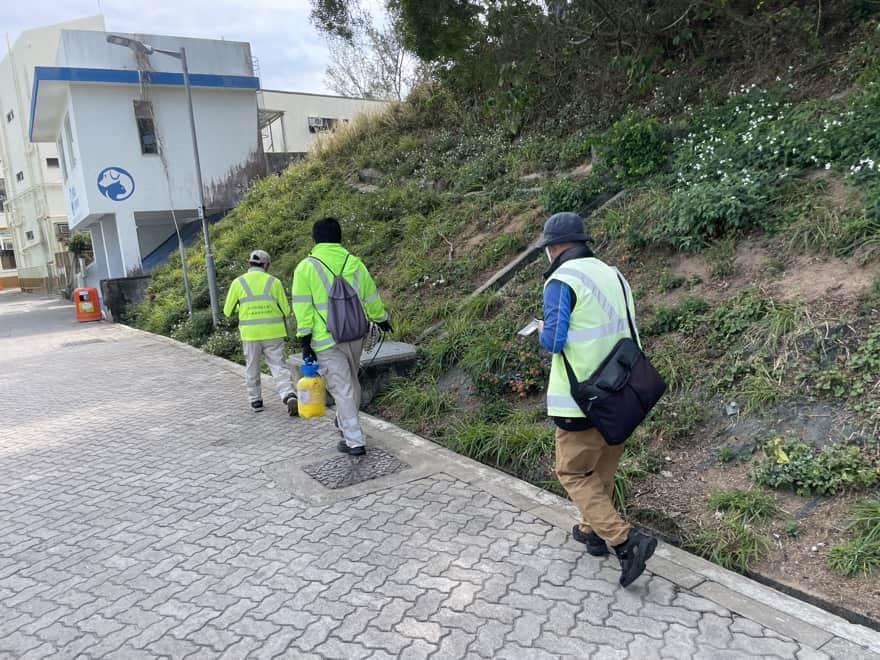
I see FEHD “death squads” as I think of them wandering around, spraying etc etc.But no attempt to involve the local community. Woeful publicity; the “No stagnant water, no mosquito breeding” campaign I remember from years ago has vanished. Terrible posters, unlike in Australia and more with advise on eliminating mosquito breeding places, as under plant pots etc etc. I’ve come across info on a “mosquito bucket of doom” that people can set up, very simply: just need a “bti dunk” which it seems some governments can supply. Something like this could help I think; but FEHD favours chemicals, not community relations.
A couple of mosquito bites won’t kill you!
Also it seems there is now paranoia about mosquitoes.They are native to Hong Kong, and small numbers should surely be tolerable.I used to spray myself before walking woodland paths here on Cheung Chau; no longer, as it seems FEHD’s death death death to mosquitoes approach is so effective. [and, also almost no interesting birds to see either] There could be education here, too.
Oversight?
Well, it seems to me that from your office, you have a very different impression of contractors’ squads actions to what happens in practice.I’ve mentioned squirting pesticide on bare ground, grass etc; not seeking out places with water for bti. Just force of habit, hard to change. Contractors’ squads could do better; they are aware of causing deaths to non target species. But for some reason, seems they feel obliged to continue with the death death death by poisoning policy.
Long way to go
Most of the above is not new; just echoes previous emails to FEHD, and answers from you can be much the same too. I’d love to see a rebound in Cheung Chau wildlife; great if Kowloon Park, for instance, again became a top place to look for songbird migrants. But it would take changes; including towards trapping etc etc. And a bit less of a “scorched earth” approach to mosquitoes; a bit of tolerance, while keeping alert to whether there actually is a disease like dengue or the emerging chikungunya in the vicinity. Again, I hope for changes for the better; but based on experience, I expect the sorry state of affairs to continue.
Cypermethrin illegally approved by European Commission
From an article that indicates the controversial nature of cypermethrin:
the Court of Justice of the EU concluded that the European Commission acted unlawfully by re-approving cypermethrin in 2021, with major gaps in the reapproval dossier, by relying on unscientific and unrealistic risk mitigation measures for insects, and by not evaluating the long-term toxicity of at least one cypermethrin-based product. The EU Court reminded that the European Commission’s decisions must be science-based and sufficiently motivated.
….
The judgement highlights that the European Commission cannot sidestep the European Food Safety Authority (EFSA) scientific conclusions without providing strong and evidence-based justifications.
”EFSA had clearly stated that no safe use of cypermethrin could be identified under realistic conditions. However, the Commission went against that opinion by fabricating non-validated risk mitigation measures, such as an unrealistic 99% reduction in spray drift, pretending it would make the use of the substance safe. This case is unfortunately not isolated: it is a recurrent practice,” added Salomé Roynel, Policy Officer at PAN Europe.