Home » Posts » News and Views » Pesticides versus Hong Kong mosquitoes killing too much other wildlife
Email to director of the Food and Environmental Hygiene Department, after multiple correspondence with other FEHD officials failed to achieve progress on issue of over zealous use of pesticides versus mosquitoes killing considerable other wildlife:
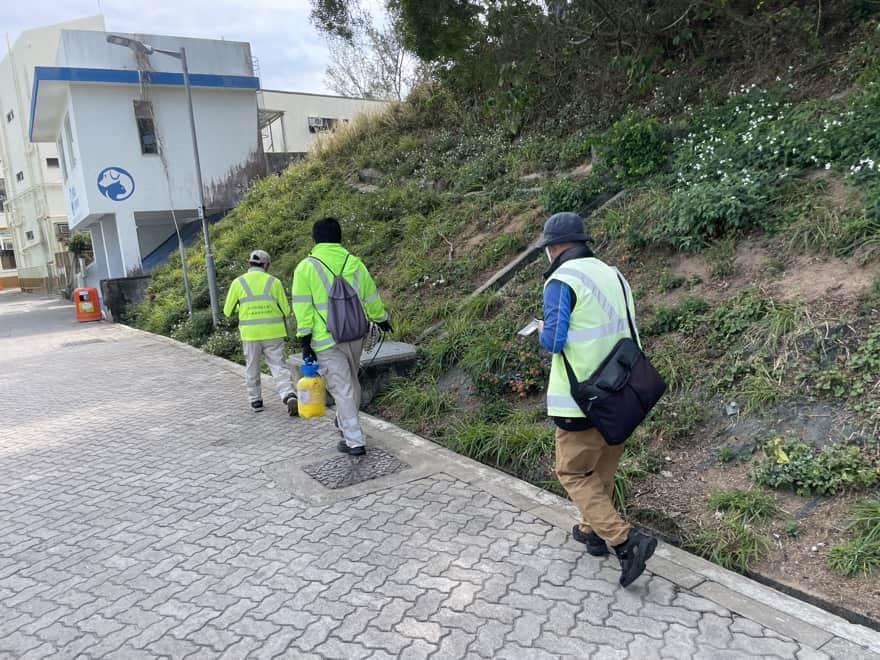
Pesticide squirted, as if just for the sake of squirting by a path
I’m a birdwatcher living on Cheung Chau, and have made numerous complaints to FEHD regarding fogging and spraying insecticides for mosquito control.
Yes, I appreciate that mosquitoes – including Aedes albopictus – are important vectors for diseases including dengue fever, and now chikungunya.
However, I also believe the use of pesticides versus these mosquitoes is too often excessive, and often extremely poorly targeted
– and that this in turn kills substantial other wildlife.
Also, FEHD officers have contacted me sometimes, perhaps saying the FEHD contractors’ teams would adopt better approaches, but there has been little real progress.
Disastrous impacts on other wildlife
Numbers of moths, beetles and other insects have plummeted around our home in recent years, surely as a result of the pesticides.
This in turn has reduced numbers of insectivorous birds, which I used to find in fair numbers. Also frogs and toads.
Importantly, too, this is surely not just a Cheung Chau issue.
Pesticide fogging at Tamar Park: does not look like habitat for mosquito breeding; surely few here
Kowloon Park, for instance, was formerly a birdwatching hotspot; but has become significantly worse for birds in recent years. Birdwatchers have seen abundant pesticide being applied there – surely no coincidence.
Perhaps in response to my complaints, there was some change, from a reliance on a wide-spectrum insecticide [permethrin], to at least some use of bti toxin.
Bti toxin: not an answer in itself
At first, use of bti toxin seemed to me excellent, as I read it is specific to mosquito larvae; hence should avoid killing other species.
But, I have seen this or other insecticide readily squirted at various places with no water for mosquito breeding; like short grass, even bare earth with almost no plants.
Plus, there seems to be quite a smell after bti is applied, so it seems there are other chemicals accompanying it?
Contractors don’t care??
It appears that the contractors and some of their team members don’t really care; I believe they are just aiming for zero or near zero mosquitoes trapped in sampling places. Perhaps that’s the viewpoint of the contractors; worried that FEHD will complain if mosquitoes are detected.]
Maybe the teams are simply not really trained, educated in just what is being attempted, which should be targeting places where there may actually be mosquito larvae. So even small amounts of water, maybe in trees, but especially in lap sap etc.
Squirting pesticide at vegetation by a path; seemingly random
Alternatives???
More careful application of pesticide
I have often been told that contractors’ teams will be advised to use pesticide more carefully.
Yet seen it still applied carelessly.
An improvement here would be welcome. Including bti toxin applied where there is some water where Aedes mosquitoes may breed.
More publicity about mosquito breeding places around people’s homes
I remember Hong Kong having promotions about “No standing water. No mosquito breeding”
But nowadays, not seeing such promotions.
I’ve looked online, various places like Australia aim for eye-catching, memorable public relations campaigns.
Aussie promotion re eliminating mosquito breeding places around homes
Then, if people help by checking their homes, might also impact mosquitoes overall.
– we check around our home. Did have some water with mosquitoes breeding; after watering an indoor plant. Of course, made sure this place is now dry.
Non pesticide spraying approaches: traps
I have also seen that mosquitoes can be trapped, killed, as the females lay eggs.
Information on In2Care claims their mosquito “stations” can decrease mosquitoes within around 4300 square feet, so around 400 square metres.
I see you use these traps, but mainly for monitoring mosquitoes?
What about increasing the numbers, densities, see if these traps can have a significant impact?
No need to be over wide areas, perhaps; but along the most used sections of paths, such as by housing – where people are more likely to be bitten if there are mosquitoes.
I know a public housing area that perhaps uses such traps; has few or no mosquitoes, but also enough insects that it is a hotspot for small migratory birds.
Well, I am sure your team in FEHD can come up with better, if you agree it is worthwhile finding how to control mosquitoes with minimal impact on other wildlife.
Hope so!
Facebook Comments
I posted the above to Facebook; here are some comments:
We live on Lamma and stress about the same. Would be good to find out if we can build some sort of coalition around this as it is a HK wide issue. Any sense of whether there are any local NGOs working on this?
I have also complained about this on Lamma
We used to have bees, butterflies and dragonflies everywhere, ladybugs too. It’s quite worrying to have them spraying everyday and at every drains, along pavement and at every park in our area. Now we are left with tons of mosquitoes and cockroaches.
Couldn’t agree more that a public info campaign is needed about standing water. Trays under potted plants are seen everywhere. If people know they’re putting themselves at risk of mosquito-borne diseases there will surely be behavioural change
Auto-translated: Thank you for your efforts. Everyone knows that the work you are doing is thankless. We understand that officials, to cope with pressure from higher-ups and complaints from the public, often resort to the simplest actions to prove that they have actually done something. Widespread spraying of insecticides is one of the most direct methods. At least it shows people that something is being done, and in the short term, it seems effective in reducing mosquito problems. For officials or most citizens, other forms of life simply don’t matter, and most people, for the sake of convenience, won’t consider using sustainable or environmentally friendly methods to replace the existing system. In this regard, those of us involved in bee conservation feel this deeply. Breaking this deadlock seems extremely difficult at the current stage.
多謝你嘅付出。
次次噴完之後果日,仲多左俾蚊咬。
都唔知係唔係上一級掠食者俾殺蟲水攪掂左。
蚊又大量第二係度飛過黎。
Auto-translated: Thank you for your efforts. Every time after spraying, the next day I end up getting bitten by mosquitoes even more. I don’t know if the higher-level predators have been taken care of by the insecticide. The mosquitoes are swarming again in large numbers.
我都住長洲,以前行山頂道的確好多唔同種類昆蟲,逢夏天會見到手掌咁大既
仲有蟬,近5-6年
差不多已絕跡在路邊,蟬亦少了很多,唔想比蚊咬自己噴蚊怕水好了!
Auto-translated: I live in Cheung Chau. In the past, there used to be many different kinds of insects along the mountain trail. Every summer, you could see ones as big as a palm, and there were also cicadas. Over the past 5-6 years, they have almost disappeared along the roadside, and there are far fewer cicadas. To avoid being bitten by mosquitoes, it’s better to just spray mosquito repellent!
Thanks so much!!! Pesticides is no doubt one of the biggest environmental problem.
below data is from Cheung Chau volunteer of HKBWS (SSRG). Although we can not confirm the reasons of the rising mortality rate from year 2021, we think that it may related to decrease of all insect by increasing usage of insecticide.
[[from surveys of nesting Barn Swallows]]
Reply to my email, from FEHD
Received on 11 December 2025:
Thank you for your email dated 10.11.2025 concerning mosquito control in Hong Kong.
Mosquitoes are vectors for various diseases that can threaten human health and they may also cause nuisance to our daily life. The Food and Environmental Hygiene Department (FEHD) plays a crucial role in the control of mosquitoes in Hong Kong, including abating mosquito infestations in the public areas as well as providing technical advice on mosquito prevention and control to other departments and stakeholders. FEHD adopts the principle of Integrated Pest Management (IPM) in our mosquito control strategies, with emphasis given to environmental control and source reduction, which is the most fundamental, effective and sustainable approach.
Environmental control by elimination of stagnant water weekly could effectively interrupt the life cycle of Aedes albopictus, the local vector of Dengue Fever and Chikungunya Fever, which mainly breeds in small water bodies, including small containers. In addition to environmental control, our mosquito control operation is also supplemented by biological control, chemical control, legislative control and health education.
Whilst our major mosquito control strategy is mosquito breeding source reduction, larvicide which can control mosquito larvae would be applied to stagnant water that could not be removed immediately. FEHD is conscious on the fact that pesticides might pose hazards to our environment and non-target organisms; therefore, the use of B.t.i. – a biological control agent that specifically targets at larvae of some Dipteran flies, including mosquito – has been introduced for mosquito control in ecologically sensitive environment. Both liquid and granule form of B.t.i., which are being used by the FEHD, do not produce a strong chemical odour. No other pesticides are required to be applied together with B.t.i.
Adult control by Ultra-low Volume (ULV) fogging only provides a short-term and temporary suppression of adult mosquito population and would only be conducted when the situation warrants. Adult control by ULV fogging only targets at densely vegetated areas that provide resting places for adult mosquitoes. In view of the short activity range of Aedes albopictus, ULV fogging operation only targets at densely vegetated areas that fall with 100m radius from areas of high human concentration, e.g. housing estates, schools, hospitals, etc., and would be extended to 250m during the focal control of Aedes-borne disease cases to ensure complete coverage of mosquito activity range. These areas are minimal when compared to all green areas in Hong Kong, which cover about 78% of the total land area in Hong Kong where most wild lives inhabit.
In addition to the conventional mosquito control measures, FEHD keeps updated on and continues to explore the applicability of new mosquito control methodologies and technologies. In recent years, the FEHD has widely adopted the use of a new mosquito trapping device as a supplementary tool to our mosquito control programmes. The mosquito trapping device utilises the female mosquito itself as an auto dissemination medium of an insect growth regulator to control other small water bodies that could not be reached or detected by humans and prevents immature mosquito from hatching into adult. The FEHD has also introduced this new trapping device to other government departments as well as relevant stakeholders.
To monitor the distribution and density of the local vector of Dengue Fever and Chikungunya Fever, FEHD carries out routine dengue vector surveillance with the aid of Gravidtraps in selected locations throughout the territory. Surveillance result helps to identify locations with vector mosquito activity and allows better allocation of resources for mosquito control in targeted areas.
Successful and sustainable mosquito control work could not be achieved without community participation. Health promotion is one of the essential components in our mosquito control programmes. Health messages to promoting mosquito prevention and vigilance against contraction of mosquito-borne diseases to the members of the public and different stakeholders are disseminated via various channels. Territory-wide inter-departmental anti-mosquito campaign is being held every year to heighten public awareness on the potential risk of mosquito-borne diseases as well as to encourage community participation and forge close partnership of government departments concerned in anti-mosquito work, especially in the prevention and clearance of water accumulations. Furthermore, thematic seminars and outreaching talks are organised for different targeted parties (such as schools, property management offices, construction sites, etc.) every year. The health messages are further disseminated through distribution of leaflets and display of posters at different venues. The FEHD has been promoting the weekly mosquito inspection programme for years to encourage venue management to conduct inspection at least on weekly basis to identify potential mosquito breeding places for timely clearance to prevent breeding of mosquitoes.
It is important to ensure the pest control services provided by the contractors are up to standard and follow strictly to the contract requirements. Only trained and experienced operators are qualified to provide the services. Furthermore, FEHD has also taken measures to strengthen monitoring of services provided by the contractors to ensure their mosquito control work is properly discharged. Pest control service contractors are required to provide services according to the provisions of the contracts. Performance requirements of the contractors are clearly stipulated in the contracts. In the event of any irregularities, defaults or non-compliance with contract provisions, the Department will take follow-up actions, including the issuance of warnings and default notices coupled with deduction of monthly payments. Such performance records will also have a bearing on the tenderers’ future bidding for the Department’s outsourced service contracts.
The FEHD has been and will continue, on one hand, to protect the health of the public by carrying out effective mosquito control so as to lower the risk of local transmission of mosquito-borne diseases in the community, and on the other hand, to minimise the environmental impacts that might arise from the course of the mosquito control work without jeopardizing survival of non-target animals.
My delayed response to FEHD
Sent on 7 February 2026:
Thank you for your email of 11 December regarding mosquito control – and biodiversity – in Hong Kong.
While lengthy and informative, I believe your email avoided some of my queries etc, and rather glossed over the impacts of mosquito spraying on local wildlife [and potential impacts on humans, too].
It is my impression that the FEHD lacks scientific experts who can oversee mosquito control; and especially anyone with expertise in and concern for biodiversity.
Hence the great reliance on pesticides, which are too often over applied, and very badly used.
Yes, maybe following recommendations by pesticide manufacturers; but it’s my belief that is like following cigarette use advice from tobacco companies.
And yes, B.t.i. seems an excellent option.
Yet I have seen it being squirted on, for instance, small shrubs and even grass – ie not targeting water where there may be mosquito larvae.
The 100m limit for fogging seems arbitrary.
And altogether, the area affected is by no means small.
Plus, the pesticide and other chemicals used in fogging drift: I’ve smelt fogging in my home when over 50m from a fogging operations.
I believe this drift is quite enough that with repeated foggings, the biodiversity in much of Cheung Chau woodland, especially in the southeast, has been severely impacted, even devastated. Birds are fewer. Marked reductions in insects such as butterflies, lychee bugs, ladybirds and more.
Even squirting pesticide, rather than fogging, is not splendidly localised, either.
The more times there is fogging and squirting, the more pesticide is spread, and doing unintended harm.
And happens multiple times per year; favouring areas close to mosquito detecting traps – surely aiming to reduce numbers caught in traps, no matter with any consideration about the overall situation [including whether ANY mosquitoes should be tolerated – it seems the aim is for zero tolerance, and of course this means hammering biodiversity
Also, a dengue vector cannot spread dengue without actual dengue; which, happily, remains rare here, albeit local resurgences are likely. And chikungunya is another concern.]
Wrecking ecosystems like this also reduces natural predators of mosquitoes.
Hence leading to more reliance on pesticides …
Community participation?
Maybe from your office you think this happens; but in practice I don’t see any – not even at the height of the dengue outbreaks near my home a few years ago.
You have terrible publicity; dull and boring posters, if any are to be seen at all.
I’ve written before of Australia etc, with far “punchier” promotions regarding reducing mosquito breeding sites.
Even remember HK radio, with “No stagnant water, no mosquito breeding” some years ago.
My wife is from Indonesia; she helped there, when a student, with talking to people about mosquito control, even giving pellets to go in water tanks and kill larvae.
So it’s left to the FEHD teams.
And, really, trained and experienced operators??
Are you having a laugh?
Or maybe from your office, you imagine this is the case.
I’ve photographed and written of FEHD contractors’ personnel squirting anti mosquito pesticides at small shrubs, grass, even bare ground; certainly with no appearance of searching for and targeting stagnant water.
It looks like they feel obliged to spray, spray and spray, with no concern about efficacy – presumably believing otherwise no pay, or some complaints especially if one person happens to report one mosquito bite. [Yes, I’ve been told there is no obligation to use all the chemicals, but I see what happens.]
Once, I picked up a receptacle to check the label – it was cypermethrin as I recall.
One of the team then made sure I cleaned my hands – but gave me water for this. The pesticide is not water soluble, however, so surely it should be washed from skin with something more like alcohol, or a soapy liquid. If trained, why didn’t he know this?
As to trapping: it seems to have potential.
But why does there seem to be so little trapping?
I know a private estate where there is trapping, perhaps including a trap with some sort of electronic power [for a lamp??]. A remarkably good place for insectivorous birds, some of which stay for days or weeks – so the overall biodiversity would seem relatively healthy.
Cheung Chau used to have insectivorous migratory birds arrive, and stay for perhaps weeks or months.
No longer.
To me, this is deeply sad; and indicative of the huge impacts of the intensive pesticide use.
I fantasise about a return to days when I could walk around, and again see birds like these; as well as the various insects etc etc.
While here, a very little from scientific research regarding pesticides, which I’ve noticed recently.
As I have sent before, there is far more information to find.
//70% of the soils in Europe contain traces of pesticides and that pesticides have a major impact on soil ecosystems and soil biodiversity:https://rdcu.be/e1bBm 1) our study demonstrates that pesticides have a clear impact on soil biodiversity and are a major disturbance to soil ecosystems (some organisms benefit, like a range of bacteria, while others are suppressed (like beneficial mycorrhizal fungi) 2) a wide range of pesticids are very persistent in soils and can stay there for years, even decades. Many pesticides are much more persistent as their half-life time indicates. 3) Unfortunately, many pesticides are not very specific and not only target pests but also other organisms including several beneficial soil organisms (such as mycorrhizal fungi). 4) if a farmer sprays pesticides, large amounts (up to 70%) do not only reach the targeted pest, but fall on the soil or end up in the air.//exTwitter thread here:
Some further reflections on our recent findings that 70% of the soils in Europe contain traces of pesticides and that pesticides have a major impact on soil ecosystems and soil biodiversity:https://t.co/bLA1tGMPCU
Also perhaps of interest: From France, signs of recoveries in insect and bird populations after some reduction in pesticide use [neonicotinoid ban, in this case] Full recovery could take years.
Dengue Suppression by Male Wolbachia-Infected Mosquitoes
Another day, another email to FEHD from me; re another form of mosquito-borne disease control that should have minimal adverse impacts:
A friend on exTwitter has just posted a link to a new paper on a study on the efficacy of Dengue Suppression by Male Wolbachia-Infected Mosquitoes in Singapore.
You will know of but failed to mention this technique; instead continuing to favour the sledgehammer/ blunderbuss-shotgun approach of pesticides – which is proven despite the known adverse impacts on other wildlife and even people.
//Insecticides, which are relatively expensive and can linger in the environment, killing other beneficial insects and damaging human health, can be used less frequently//
Well, I know of the term “smart city” for Hong Kong; yet also of there being a tendency to find reasons not to use new technologies etc.But, perhaps this control method is well worth trying; Hong Kong could become a hub for more advanced mosquito control in the Greater Bay Area/s China ??